
Is Outer Space a Common Pool Resource?
(Not quite!); Thinking about outer space in the context of common pool resources

When I took microeconomics again in grad school, I wanted to think and apply some ideas to my work in the space industry. I found Common Pool Resources (CPR) management and the tragedy of commons to be fascinating and I started to apply these ideas in my public policy paper and graduate internship.
To set the stage for this blog, I want to start with CPR as it frames much of my thinking and analysis. I recognize that many people in the space industry disagree about whether space qualifies as a CPR. So, let’s examine the CPR definition, and explore whether aspects of outer space fit this classification.
What is a Global Commons and a Common Pool Resource?
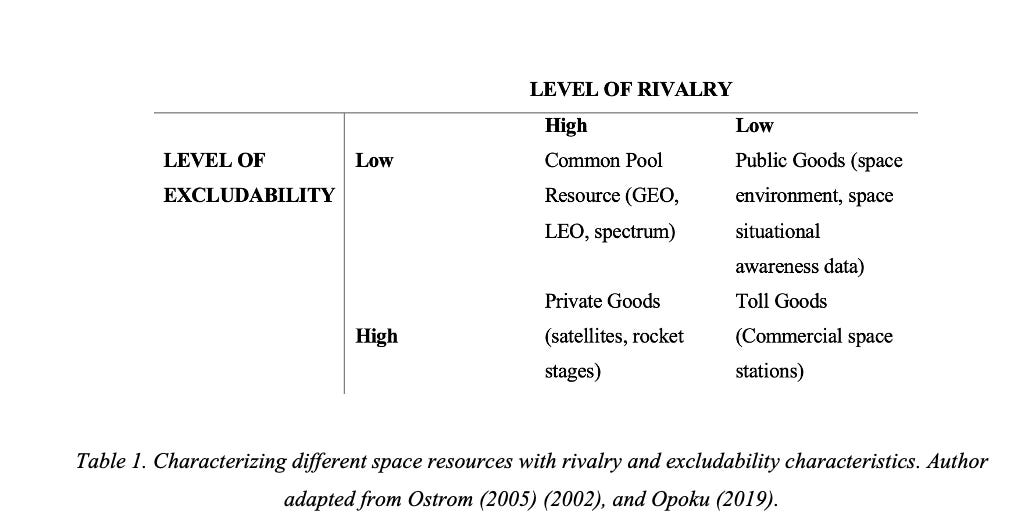
"Global commons" refers to international, supranational, and global resource domains in which common-pool resources are found. In economics, common goods are rivalrous and non-excludable. (This is different from public goods, which are non-rivalrous and non-excludable.)
Understanding Rivalry and Excludability
Rivalry refers to situations where an entity’s use of a resource does not diminish another entity’s capacity to use it. Excludability means that one entity’s access to a resource does not limit other’s access to the resource.
How would Space be a Common Pool Resource?
Like the atmosphere, outer space is a global commons - vast and consumable/accessible by everyone. Within space, various orbits (e.g. LEO, GEO) serve as ‘roads’ for satellite operations. These orbital ‘roads’ can be considered as Common Pool Resources, they are rivalrous but non-excludable; anyone can have a satellite in orbit but because of limited capacity, countries can’t put unlimited satellites in LEO or GEO. On excludability, any country or company with the technology (launch vehicle or satellite) and license can launch and operate in space, and no-one can exclude any other from accessing space at any orbit. On rivalry, because of carrying capacity, there is a limit to which the orbit can sustain satellite activity before it is deemed unsafe, and there’s also spectrum interference constrains. I summarized these with the diagram1 below2 and took the liberty to add a few more examples.
The Tragedy of the Commons
There are a few implications to thinking about outer space in this context: Global commons and CPR issues are difficult management challenges because they require high coordination between actors. In some cases, their consequences transcend national boundaries (e.g. climate talks have international coordination problems but the negative externality is shared by everyone suffering from climate change). Similarly, to operate in the space environment, high coordination is required and the consequences to mismanagement of the space environment can be catastrophic (e.g. a debris creation event).
The tragedy of the commons refers to actors behaving in self-interest, leading to overconsumption and eventual depletion of the CPR. How would this look like for outer space? Highly competitive firms will try to send as much of their satellites to orbit as they can foresee the limited capacity of LEO and the space environment being increasingly congested. Therefore, state and private actors would be incentivized to gain an orbital ‘slot’ and access space before the orbits become too congested to operate in. One can already see this with the announcements and deployments for megaconstellations and satellite fillings. While the constellation maturity range varies from operational (Starlink, OneWeb) to in development (Kuiper) to aspirational (Astra, E-Space), the high number of (paper) satellites show an increased interest for providers to have a satellite in orbit as space continues to get more congested.
Thinking about policy and economic solutions
I’m not asserting that outer space is a global commons or that definitely orbits are CPRs, thinking about the space environment in this context can help us apply different policy ideas from other industries. There are many ideas in the commons management literature that we can consider (for some of these ideas, I will try to write a post on them). Here are some ideas:
Quantities: The government can implement quotas or introduce licenses to limit access to resources or control exploitation. Many countries implement fishing quotas, logging permits, or an emission cap. For outer space, one can impose a limit on how many satellites can be in a certain orbit at a moment in time.
Price: The government can implement taxes to put a price on negative externalities imposed by the actors. Examples include carbon tax, congestion tax, and sugar tax. For outer space, one can impose a tax on launch or a debris tax.
Regulations: The government can introduce regulations such as licenses requirements to increase compliance. For outer space, an example can be the FCC requiring operators to have an orbital debris mitigation (ODM) plan.
Incentives: The government can implement incentives to promote good behavior in outer space, for example, the government can reward space debris removal companies contracts to service a satellite or other incentives to promote sustainable practices,
Property Rights: The government can allocate property right (it is tricky to do this for space, because of the Outer Space Treaty, but I want to talk about this in another post)
Collective Governance: Decentralized management frameworks like polycentric governance can promote industry-led initiatives for collective action.
Norms and behavior: Establishing norms through discussion and emphasis of reputation, similar to Net Zero Debris and Space Sustainability Rating initiatives in the space industry.
The goal of my blog will be to tackle explore these policy questions of how we can apply existing programs or public policy/environmental economics ideas to the space sector.
In conclusion: Is Outer Space a Common Pool Resource?
Not quite, while outer space as a whole is a global commons, specific orbital regions like LEO and GEO exhibit characteristics of CPRs. Instead of broadly labeling space as a CPR, a more precise approach—examining subdomains—can help us develop effective solutions to prevent the tragedy of the commons in outer space.
Ostrom (2005), (2002)
Opoku, A. (2019) Sustainable development, adaptation and maintenance of infrastructure. International Journal of Building Pathology and Adaptation, 37 (1), 2-5 doi:10.1108/ijbpa-02-2019-074